Mastering the EU Joint Clinical Assessment (JCA)
Your Path to EU Market Access
EU HTA & Joint Clinical Assessment
JCA readiness starts before the JCA.
The EU Health Technology Assessment Regulation (EU 2021/2282) has changed how clinical evidence is assessed for market access across Europe.
Since January 2025, Joint Clinical Assessment (JCA) has applied to new oncology medicines and advanced therapy medicinal products (ATMPs). The framework expands to orphan medicines in 2028 and all centrally authorised new medicines by 2030.
JCA provides a common European assessment of the relative clinical effectiveness and safety of a new health technology. Pricing, reimbursement and judgements on added value remain national.
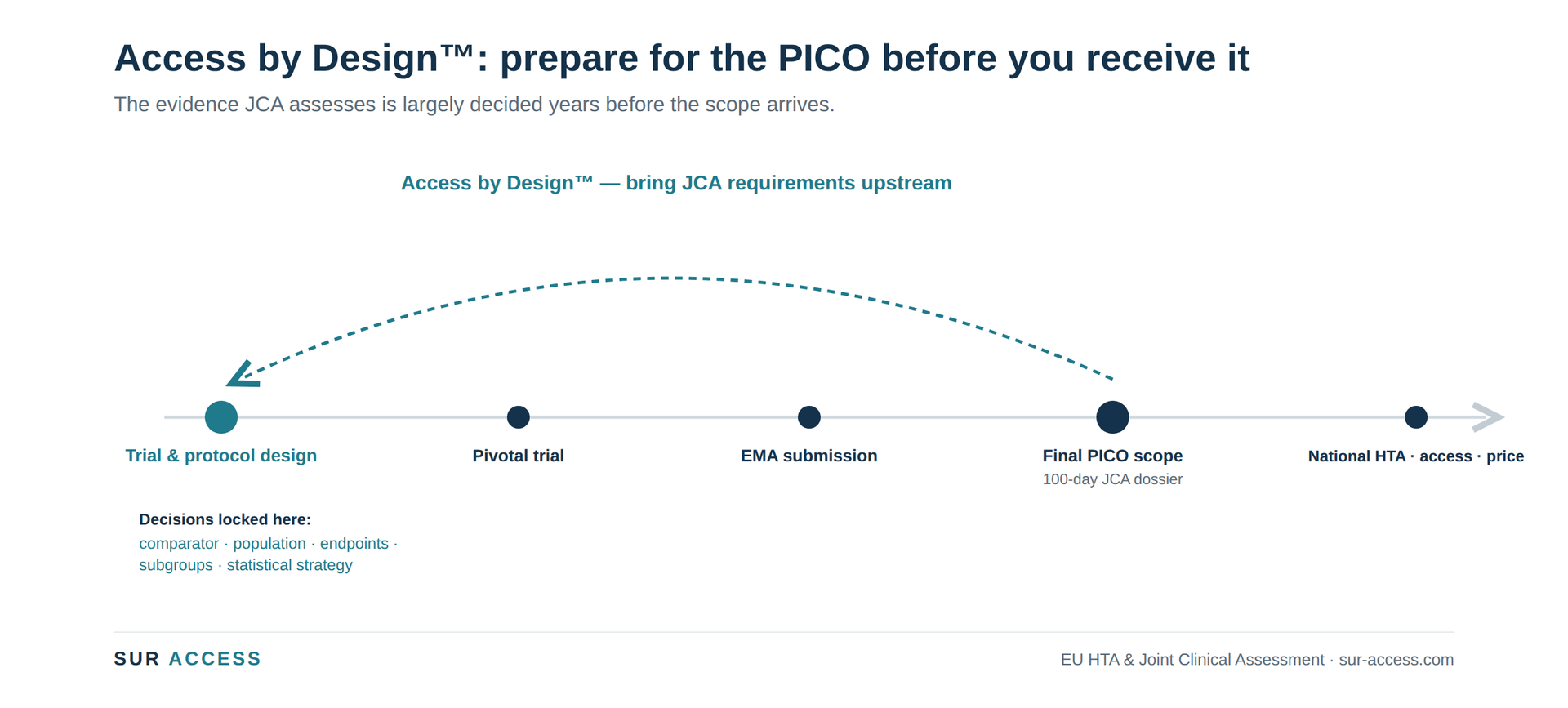
But the evidence assessed at JCA is largely determined much earlier.
Comparator choice. Patient population. Endpoints. Subgroups. Statistical strategy.
By the time the final JCA scope arrives, many of the most important evidence decisions have already been made.
That is why Sur Access approaches JCA as an evidence strategy problem first — and a dossier problem second.
The JCA challenge
One development programme. Multiple evidence questions.
The JCA assessment scope is structured around PICO questions:
Population · Intervention · Comparator · Outcomes
These questions reflect the information needs submitted by Member States and consolidated into the final European assessment scope.
A global pivotal programme, however, was rarely designed to provide direct evidence against every comparator, in every relevant population and subpopulation, that may emerge through that process.
This creates several strategic challenges.
PICO complexity
The final scope may contain multiple PICOs reflecting different populations, treatment pathways, comparators and outcomes across Europe.
The challenge is not simply predicting how many PICOs there will be.
It is understanding which evidence questions your development programme can answer directly, which require indirect evidence, and which may remain genuine gaps.
Comparator alignment
The control arm that supports regulatory approval may not cover all comparators relevant to European HTA.
Where direct evidence is unavailable, the feasibility and credibility of indirect treatment comparisons become critical.
Populations and subgroups
The EMA indication and pivotal-trial population may be broader than the populations in which European HTA bodies ultimately need comparative evidence.
Relevant subgroups therefore need to be anticipated early enough for the necessary analyses — and, where appropriate, statistical planning — to be credible.
Endpoints and evidence certainty
Regulatory success does not automatically mean that the evidence will be equally persuasive for HTA.
Endpoint relevance, maturity of survival data, multiplicity, patient-reported outcomes, missing data, treatment switching and other sources of uncertainty can all influence how confidently comparative effects can be interpreted.
Compressed execution
Once the final assessment scope is communicated, the Health Technology Developer has a limited period to complete the JCA dossier — generally 100 days, or 60 days for medicinal products undergoing accelerated EMA assessment.
That is not the time to discover that a key comparator cannot be addressed.
Access by Design™
Prepare for the PICO before you receive the PICO.
Sur Access brings JCA requirements upstream into clinical and evidence strategy.
The objective is not to predict the final assessment scope perfectly.
It is to make the development programme resilient to the range of clinically plausible PICOs it may face.
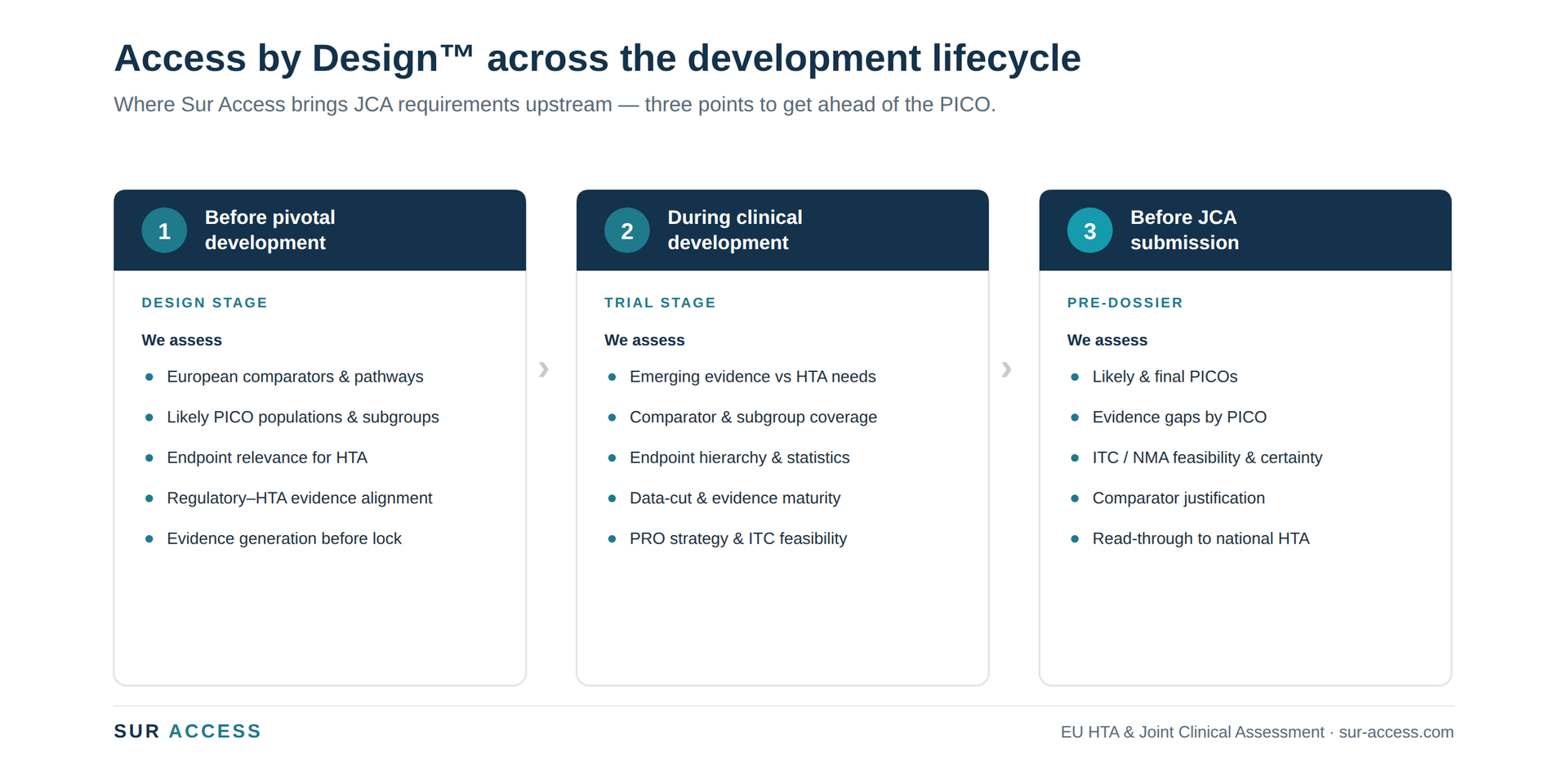
Before pivotal development
We assess:
- Likely European treatment pathways and comparators
- Potential PICO populations and subpopulations
- Endpoint relevance for HTA
- Alignment between regulatory and HTA evidence requirements
- Evidence-generation opportunities before protocol lock
During clinical development
We assess:
- Emerging evidence against anticipated HTA requirements
- Comparator coverage
- Subgroup and population evidence
- Endpoint hierarchy and relevant statistical considerations
- Data-cut and evidence-maturity implications
- Patient-reported outcome strategy
- Feasibility of indirect comparisons
Before JCA submission
We assess:
- Likely and final PICOs
- Direct evidence coverage
- Evidence gaps by PICO
- ITC/NMA feasibility
- Evidence certainty and major sources of uncertainty
- Comparator justification
- Additional analyses required
- Implications for subsequent national HTA
Clinical evidence → JCA → national HTA → access → price & commercial value
JCA Evidence Gap Analysis
Know what is covered — and what is not.
Sur Access can stress-test an existing clinical programme against the European evidence requirements it is likely to face.
For each relevant PICO, we assess whether the available evidence can provide:
Direct comparative evidence
Where the pivotal programme directly addresses the relevant population, comparator and outcomes.
Indirect comparative evidence
Where credible ITC or network meta-analysis may bridge the comparator gap.
Supportive evidence
Where evidence can strengthen interpretation but cannot replace the required comparative analysis.
An unresolved evidence gap
Where the available programme cannot robustly answer the question.
The result is a prioritised strategy:
What is covered.
What needs additional analysis.
What additional evidence may be worth generating.
What cannot realistically be fixed and needs to be managed.
Not every JCA evidence gap should be closed.
Only the ones worth more than they cost.
The strategic question is not simply whether an evidence gap exists. It is whether that gap is likely to matter for subsequent HTA, access, pricing and commercial value — and whether addressing it is worth the investment.
Comparative Evidence Strategy
When head-to-head evidence is not available
A pivotal trial cannot include every comparator used across Europe.
Indirect comparative evidence therefore needs to be planned rather than treated as a last-minute statistical exercise.
Sur Access supports:
- Comparator landscape assessment
- Feasibility assessment for indirect treatment comparisons
- Network structure and evidence availability
- Population similarity and effect-modifier assessment
- Anchored and unanchored comparison strategy
- Network meta-analysis planning
- Evidence-generation recommendations where a credible comparison is not currently possible
Where specialist statistical execution is required, the appropriate evidence-synthesis expertise can be integrated into the project.
JCA Dossier Strategy & Support
Sur Access provides strategic support through JCA preparation and submission, including:
- PICO strategy and evidence mapping
- Comparator identification and justification
- Evidence-gap assessment
- Comparative evidence planning
- Population and subgroup strategy
- Clinical outcome and safety evidence strategy
- Evidence-certainty and uncertainty management
- Review of JCA analyses and narratives
- Alignment with relevant regulatory clinical documentation
- JCA dossier strategy and review
- Preparation for downstream national HTA
Support can begin with a focused strategic review or scale into a broader JCA programme depending on the asset and internal capabilities.
JCA is joint. Market access is still national.
JCA creates a common European clinical assessment, but it does not determine price, reimbursement or national added benefit.
Member States continue to make their own access decisions and may consider additional evidence, including economic, budget-impact and country-specific information.
This means JCA should not be planned in isolation.
Sur Access connects the European clinical assessment with the decisions that follow:
JCA evidence
↓
National HTA interpretation
↓
Probability and conditions of access
↓
Pricing & reimbursement
↓
Commercial value
The objective is not simply a technically compliant JCA dossier.
It is an evidence strategy that can continue to support the asset after JCA, in the markets where access and price are ultimately determined.
JCA Masterclass & Team Workshops
Bring JCA thinking into the development team.
JCA is no longer only a market-access responsibility.
Clinical development, regulatory, biostatistics, medical affairs and market-access teams all make decisions that can affect the future assessment.
Sur Access provides practical workshops covering:
- How the new EU HTA system works
- How JCA differs from regulatory assessment
- PICO development and anticipation
- Comparator and subgroup challenges
- Evidence gaps and comparative evidence
- Real JCA and HTA cases
- What clinical and regulatory teams can do differently upstream
Programs can be tailored around your own assets and development programmes.
Prepare for JCA before the dossier stage.
If your asset is approaching pivotal development, EMA submission or JCA, the most useful question is not:
“How will we write the JCA dossier?”
It is:
“Will the evidence we are generating answer the questions Europe is going to ask?”